

It has been a while since we talked patchwork and quilting on the blog and I thought it was high time we brought you the third and final 'Essential Patchwork and Quilting Toolkit post from the lovely Joan. If you would like to read the series of three articles from the beginning you can find part one here and part two here.
These articles are great for those of you who are new to patchwork and quilting, but we would also recommend experienced patchwork and quilting fans to have a read. It is easy to continue to use the same tools or techniques you always have without question, but sometimes hearing the advice/opinion of one of your peers can teach you something new you wish you had known years ago.
In this article Joan will tell us all there is to know about template plastic, graph paper, the quilters quarter or seam wheel, freezer paper and Bondaweb. So settle down, grab a cuppa and over to you Joan...
Template Plastic
When copying block designs ready to cut fabric it is necessary to use a template. Whilst these can be made from cardboard, plastic template sheets make the job a lot easier and the templates produced will also last a lot longer. Template plastic is available to buy marked with a graph paper print or in plain sheets.

When using the sheets, it is possible to actually trace the shape off the block components using a very sharp pencil and clear ruler for accuracy, as the plastic sheets are transparent. It has to be considered at this point whether to add seam allowances to the templates or add them afterwards when cutting the fabric. Personally, I always like my templates to include seam allowances as it is all too easy to forget to add them on when cutting the fabric and we all know how heartbreaking it is to waste pretty fabric!
Graph Paper
It is very useful to have a pack of quilters graph paper to hand in case you wish to resize blocks for a project, or even design your own blocks if you are brave enough!

It is important to use graph paper designed for quilters because they are marked in 1/4" squares (6mm) with heavier marks on the inch lines. Whilst some Art shops sell graph paper marked in inches, which may at first glance seem suitable, some have 1/10" markings so do not show the 1/4" divisions causing a lot of confusion and inaccurate results.
Resizing blocks may sound difficult, but it really is very easy. You simply draw out the block to the size you require on the graph paper and this will give you the actual templates – minus seam allowances of course! If you wish you can simply use the graph paper as your template or transfer it to template plastic and add the seam allowances into the templates or when cutting the fabric depending on which method you prefer.
Quilters Quarter or Seam Wheel
When making templates, these tools can be used, depending upon your personal preference.
If you prefer to add the seam allowance to the templates, trace the shape, then use the Quilters Quarter to add the seam allowance on by placing it next to the lines you have drawn for your template and marking your cutting line before cutting into the plastic. You can also use a quilters quarter to draw seam allowances onto the fabric as shown below.

If you prefer to add seam allowances when cutting, then place the template onto the fabric and roll a seamwheel, (which has a hole in the centre for a pencil to fit in) around the template to draw the cutting line onto the fabric. A seamwheel is particularly useful for curved or round shapes.
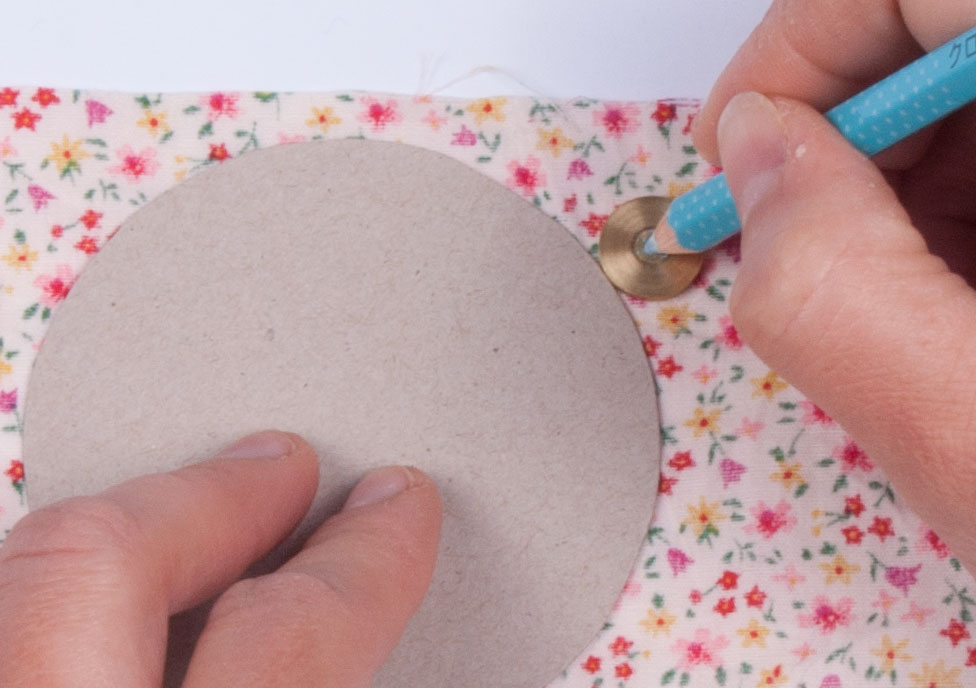
The other alternative is to cut by eye, but remember this will never be as accurate as the other methods and I personally think it is better to be safe than sorry!
Freezer Paper
Freezer paper is an American product which is intended for wrapping food when freezing. However, to us quilters that is just a waste of a valuable quilting tool!

Freezer Paper is a must for foundation piecing. You simply trace the shape onto the matt side of the paper and iron the shiny side onto the fabric. Keep the paper in place until all the machining is complete and tear it off afterwards. Freezer paper gives excellent results when used for blocks such as a Mariners Compass, resulting in really sharp points.
It can also be used for appliqué work to keep the fabrics stable whilst they are stitched in place. When using for this purpose the shapes can be peeled off and re-used, unlike in foundation piecing.
Bondaweb
Bondaweb is really useful especially for appliqué work, although unlike freezer paper it is a permanent addition to the fabric, resulting in the appliquéd fabric feeling slightly stiffer.
To use Bondaweb, which in America is referred to as 'Wonder Under', the design is traced onto the Bondaweb and then ironed on to the reverse side of the fabric.
Once this is complete, the shape is cut out of the Bondaweb and placed in position on the fabric then stitched round. Care must be taken to ensure that the placement is correct because once the shape is ironed on it is permanent.
When using Bondaweb take great care when tracing shapes onto the web to ensure that you end up with the finished appliqué shape the right way round. It is all too easy to forget to reverse the image. It is also easy to make the mistake of ironing onto the right side of the fabric!
I know these things sound so obvious but all quilters will have either had these things happen to them or will have been in a class when someone else has made the errors!
Don't forget to check out our ever growing range of patchwork and quilting fabrics available by the metre, in fat quarters, charm packs and jelly rolls with Kona solids coming soon!
I hope my advice has been helpful to you and remember we are always available to offer advice and guidance on using any of the products we stock either via email or over the phone.
Happy quilting!
Joan
For more tips and tricks on how to make sewing easy you can follow our blog via Bloglovin and receive updates via email each time a new post is added.
Follow us on Facebook and Twitter for news, tutorials, special offers, sales and more.